

about Giraffes
Fun Facts about Giraffes
Have you seen the giraffe lower its head to drink water? Something that puzzled people for a long time was why the giraffe did not burst the blood vessels in its head when it suddenly lowered its head to the ground, and why, when it suddenly lifted up its head again, it did not get giddy. The reason is that the giraffe is well equipped with valves in the arteries and veins. Moreover, the giraffe has a spongy network called the “wonder net” that protects the brain from forceful surges of blood. This wonderful “power transformer,” as it were, interrupts the blood flow through the carotid, the main artery to the brain. It disperses it into fine streams that finally reach the brain without damaging pressure. Marvelous design indeed!
The giraffe’s amazing height is just fine for the kind of food it prefers. You see, these skyscrapers of the African veld like to browse on the uppermost leaves of thorny acacia trees, which are from fifteen to twenty feet above ground. Mr. Giraffe is well equipped to dine on these tasty leaves, for his eighteen-inch-long tongue easily tears twigs and leaves from trees. But what about the sharp thorns of the acacia tree? Mr. Giraffe does not seem to mind them, probably because his lips are quite hairy, with a rough inside surface.
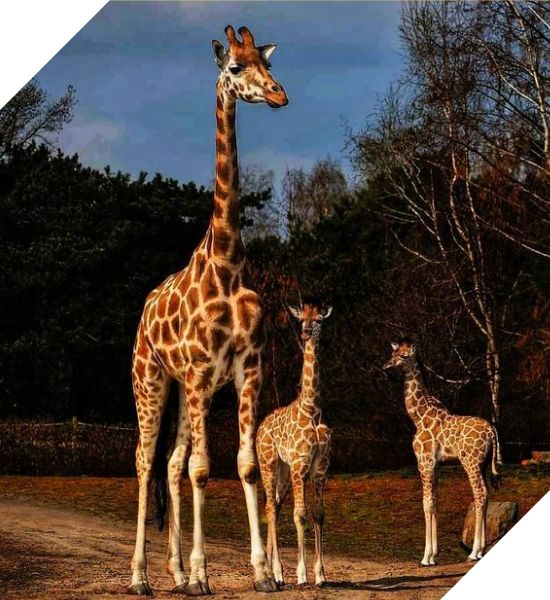
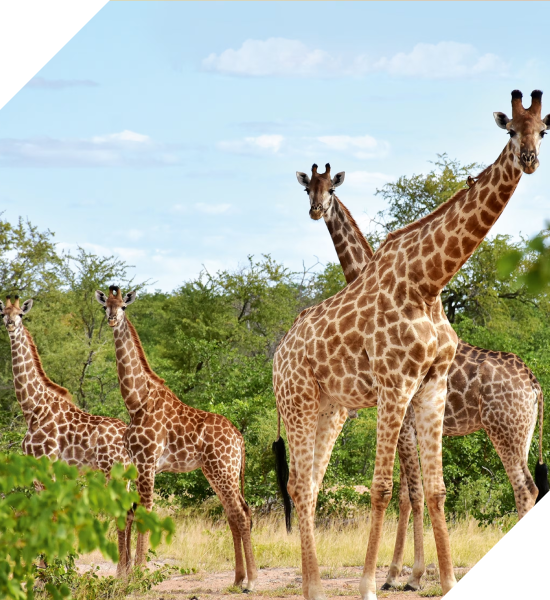
The giraffe has the keenest sight of any game animal in Africa, a zoologist once said. Its eyes can see in almost all directions without turning its head. So, Mr. Giraffe can see danger approaching from a long way off and then speedily moves away. It has been noted that when lions, attempting to attack a giraffe, realize that they have been seen, they give up the attempt. When lions do kill a giraffe, it is usually in forested country where the animal’s vision has been obscured.
Many are the fascinating facts about these towering creatures. For example, the giraffe can speed along at thirty-two miles an hour in open country. Even if there are quite a number of trees in the way, the giraffe still speeds along, avoiding collision by swaying its head and neck under branches and between trees. Swift Mr. Giraffe is not easily overtaken, even by a horse. It covers ground in a long loping gallop with great strides, traveling with what has been described as “marvelous grace of form and rhythm of action.”
It is notable that baby giraffes come into the world with a bang! For they have a five-and-a-half-foot drop at birth, head first! Experience in zoos has shown that they suffer no ill effects from this and are able to stand five minutes after birth, and to feed twenty minutes later. When grown, a large bull giraffe weighs between 3,000 and 4,000 pounds.
Today, Giraffe populations face major threats from habitat loss and agriculture, development, poaching or illegal hunting (bushmeat, body parts for trade or souvenirs), and human-wildlife conflict, exacerbated by drought & climate change, all leading to a significant decline, with some subspecies critically endangered, highlighting the need for conservation. We have partnered with wwf.org.uk., charity in the United Kingdom, to donate toward the conservation of nature’s gifts like the giraffe.
Source material about Giraffes from: Awake! magazine, December 8, 1971 pp. 10-11 as published on the website: https://wol.jw.org/en/wol/d/r1/lp-e/101971882#h=1:0-19:390